

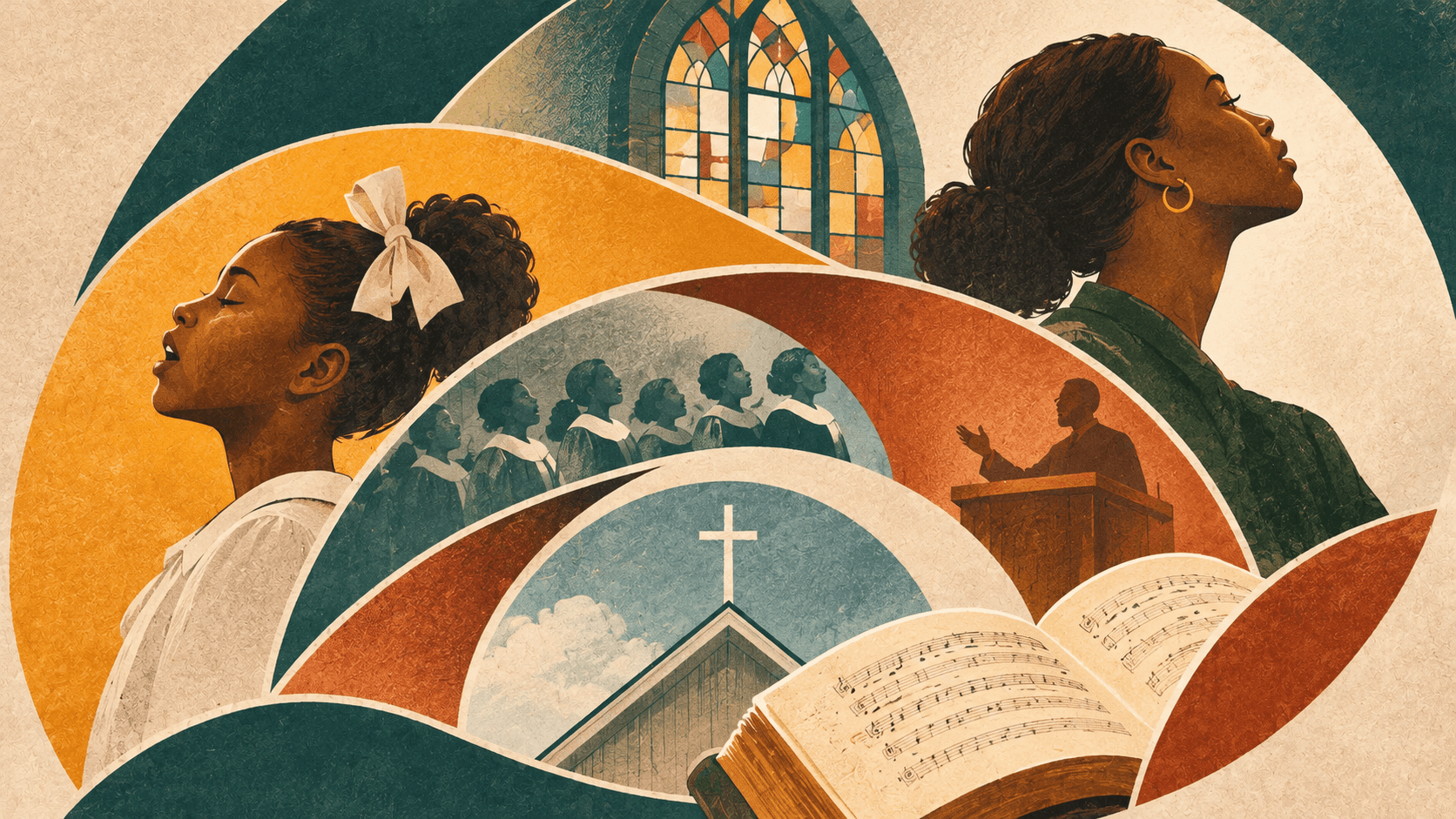
I went to church today. It’s not significant news to the average Nigerian. It is generally expected that you show up at church every Sunday. Or mosque every Friday. And when you don’t, it must be for a tenable reason like essential work, sickness, or an act of God. But if you’re me, a person who hasn’t attended church in almost 4 years, except on rare occasions, then it is significant news. So when I say to a friend that I went to church today, they respond with, “Oh, wow, that’s interesting. Why? Which church was it? How did it go?” I went to church because my friend Joy invited me to a Hymn Sunday. Five years ago, Joy and I co-hosted a hymn event we called “Nostalgia” because the new Charismatic/Pentecostal churches we attended no longer sang hymns regularly. And we missed singing hymns.
Joy now attends This Excellent Church, a denomination in the Reformed Protestant tradition. There is no visible billboard or marker, so my cab driver and I spend about 5 minutes trying to figure out which building in the estate houses the church. I assume it is one of those residential-home-turned-church arrangements, which is common for small and medium-sized churches. But the driver quickly figures out that it is the building with many cars parked outside the fence. I walk in, realising it is a dedicated church building with stained-glass wallpapers on some of the sliding windows. On the wall of the entrance are the same words I’ll later see on the backs of polo shirts worn by some members of the choir, the Latin texts in bold italics, and the English interpretation in brackets:
Sola Gratia (saved by grace alone)
Sola Fide (through faith alone)
Sola Christus (in Christ alone)
Sola Scriptura (according to Scripture alone)
Soli Deo Gloria (to the glory of God alone)
I enter a small door on the front left of the church building; one usher guides me to another usher, who guides me to the last row of the third of four seating columns on the left of the stage, viewed from the stage. The choir sits in the fourth column, immediately to my right. My view of the pulpit is partly blocked by the people ahead of me and partly blocked by a pillar in front of me. Joy told me the service would start at 9 am, and since I wasn’t sure when the hymns would be sung, I worried about arriving too late. I am even more stressed when I arrive during the sermon. In my home church, the sermon was the last event before the service ended. All other events, including hymns, led up to the sermon. It was better for people to leave the service with the word fresh upon their hearts. I settle in, and the sermon is an admonition about why we sing hymns, which surprises me. I’m even more surprised when the sermon ends less than 15 minutes after I arrive. Sermons in my home church lasted at least 45 minutes, on a not-so-serious day. And those sermons came after two other teaching sessions on the same Sunday morning.
A few months after my family moved into a new home in a new community, another family that attended a different “district” of our church moved three houses away. The man sold second-hand musical instruments and taught music theory and practice in church. Mr. F introduced my brothers and me to Gaither Homecoming music. A group of friends with individual music careers came together to sing and share fellowship, at the behest of Bill and Gloria Gaither, legends of the Southern Gospel movement, known especially for writing and composing the hymn Because He Lives. Those videos filled me with a longing for fellowship like that. In one of them, Gloria Gaither said, “Hymns are portable pieces of theology that throw us a lifeline when we’re in trouble, or when we’re having triumphs and joy; they give us something to hold on to.”
Samuel Oyeyinka, the lead pastor, is admonishing the church on the excellency of faith grounded in knowledge, not feeling. He speaks of a kind of praise manufactured in the face of uneven odds, making it a sacrifice. “There are times when music flows out of you naturally.” He makes an example of a person seeking an opportunity to “japa” who has tried many times and eventually gets a successful application. “In that situation,” he says, “You will just hear your mouth releasing osubare re o.” The kind of singing he wants the church to do today, though, is conscious. Willed. One that might require wrestling with current circumstances and feelings. One rooted in an assurance of the faithfulness of God. And what a timely message. Most of the people sitting in this room have not had electricity in at least one week, some almost a month. Lagos is hotter than it should be. Food is more expensive than it has ever been. Opportunities for success are scarcer than ever. I hold fast the belief that faith and hope are essentials of any human journey. And in this house, the charge of faith and hope is so palpable, I could almost taste it.
When the sermon ends, a member of the choir takes the pulpit and leads us into the first round of hymns. The first hymn is unfamiliar to me, but it holds the conviction of a true believer: “Come, rejoice now, oh my soul / for his life is my reward / for there my heart has found its treasure / Christ is mine forevermore.” The next hymn bears the same sentiments, cloaked in familiarity. The guitar chords introduce the hymn, and I feel warm liquid pool towards the right corner of my eye. As I open my mouth to vocalise, “Blessed assurance, Jesus is mine,” a single tear makes its way to a handkerchief I readied for it. I close my eyes, and I am 13 again. In the second row of the orthodox-style pews, the first column on the left of the altar at my childhood church. Eyes closed. Singing with grace in my heart, each word laced with conviction, “This is my story / this is my song / praising my saviour / all the day long.” I have never needed a hymnal for this one.
About ten years ago, I stood at the right end of the auditorium stage at the Faculty of Environmental Sciences, University of Lagos, where Deeper Life Campus Fellowship held their Sunday services. Sweat stuck to my skin underneath my lilac chiffon blouse and black pleated skirt. The fans whirred at full capacity, but their efforts fell short in the presence of the November morning heat. A pink patterned satin scarf slid a little backwards on my head. I sang into a microphone, “Oh Jesus, I have promised to serve thee till the end.” I had sung that same hymn many times in the 19 years of my life leading up to that moment. Today, I’m sitting in the back row of a congregation of about 500, singing it again. This time, I stumble over the words, singing some lines for nostalgia’s sake, and staying quiet on others, because I struggle to make promises I cannot keep. My vision travels to the far left corner of my view. I see a woman, her skin the colour of the sun as it unveils a new day, hands clasped against her forehead, tears glistening on her face. I can see the shape of her surrender, and unlike me, she means it when she sings, “my foes are ever near me / around me and within / but Jesus draw thou nearer / and shield my soul from sin.”
Against the backdrop of the message of grace and faith that Pastor Sam has taught, 31-year-old me wants to hold 13-year-old me and tell her that the immense guilt she carried would pale in the light of a grace she would later come to understand. Tell her that feeling unworthy did not mean her sins were counted against her. That “holiness, without which no man shall see the Lord” was neither a gun to her head, nor an achievement to attain by her own strength. That it is God who works in her to will and to do of his good pleasure. That salvation and God’s presence are facts of the excellence of God’s grace. 13-year-old me needed the sermon at TEC today. 31-year-old me does not care much about these Christian versions of grace and truth anymore. At the end of the service, I will tell Pastor Sam I enjoyed the service. That it was reminiscent of my childhood, but with a more liberating idea of grace. Tell him that I don’t really consider myself a Christian anymore. He will ask, “Why are you angry at God?” And before the words, “I’m not angry at God,” crawl out of my mouth, he will say, “Sorry, I’m projecting. When I didn’t consider myself Christian, it was because I was angry at God.”
One can only be angry about things one cares about. I feel nothing for this specific Christian version of an anthropomorphised God. But if I still cared, this would be a church I could commit to, to the degree that some of the teachings would annoy me. For example, the idea that a woman can be a deacon, but not a pastor or a “ruling elder”. I could tolerate this assembly better than most new assemblies because it tickles the part of me that prioritises scholarship and believes good knowledge can inspire behaviour change. This aligns with TEC’s mission to “reshape men’s values”.
On TEC’s website is a downloadable 130-page document declaring the church’s confession, catechism, and creeds. TEC is built upon the rock of the Nicene Creed, the Chalcedonian Creed, the Belgic Confession, the Heidelberg Catechism, and the Canons of Dort. These creeds are rendered in their original form, with addenda and notes where TEC’s doctrines, called The Doctrines of This House (DOTH), differ. For instance, on the subject of baptism, especially of infants, the church dissents from the Belgic Article 34, which proffers that children “ought to be baptized and sealed with the sign of the covenant, as the children in Israel formerly were circumcised.” TEC reserves the sacraments for those who can personally profess faith in Jesus Christ as Savior and Lord, and children are not baptised until they can make such a profession.
After each stanza of the last hymn, the notes pick up pace as if in a hurry. The choir claps to the beat of the keyboard chord. And then the notes, as if tired of running, slow down into the chorus. To which the choir and some congregants lift their hands, “O sing hallelujah / our hope springs eternal.”
When the hymn ends, Pastor Sam returns to the pulpit, inspired to lead the congregation in prayer. The style of prayer here hugs me with familiarity. As in my home church, there is no shouting or screaming. There are hums. Heads follow heart posture, as if in intimate conversation with the One who is big enough to rule his universe, yet small enough to live in their hearts. Pastor Sam asks the congregation to pray, “Father, for the sake of your son Jesus, and by his merit, have mercy on me.” I know a cry for mercy. It was, after all, my father’s prayer when I was born. It was, for many years, my prayer when I couldn’t find the words to speak the heaviness in my heart. Or when I was bereft of strength in my bones. Or when I didn’t know what to pray for. I have always imagined it to be an expression of groanings that cannot be uttered.
Pastor Sam was raised in a popular “word-of-faith” movement denomination, the expression of which is starkly different from that of TEC. He tells me after the service that his Christian journey is a cyclical one of doubt and conviction. I tell him about my apathy towards the Christian faith. He says to me, “It seems to me like your faith journey is still ongoing”, to which I reply, “Isn’t that all of us?” “True”, he responds. He says that after every season of doubt, his conviction grows stronger. He still sometimes struggles with certain mysteries, like how some people are destined for eternal damnation. And why God wouldn’t heal some afflictions. But he has made peace with his uncertainties. “There are things we’ll never know till we meet Jesus face to face.” “And you are sure you will meet him face to face?” “I am absolutely certain I will”. My thoughts about resurrection and judgment are too conflicted to bring up in the conversation, but earlier, I had abstained from the Lord’s Table because I hold respect for the sanctity of the church’s beliefs.
After the prayer for mercy, a voice speaks into the mic, announcing the time for the Lord’s Supper. I don’t see the speaker, but I hear the clanking of stainless steel cloches being separated from stainless steel trays and bowls. The speaker says all who are repentant and in faith are invited to partake of the Lord’s Table, and those who remain in unbelief are warned to abstain, lest they bring judgment upon themselves. Nostalgia grips me. Growing up, my participation in the Lord’s Supper depended on how saved I felt during the service. Today, I feel nothing. Perhaps due to the presence of the table set in front of the church, I expect the congregation to file out in order to receive the small, round flatbread and individual tiny plastic cups of wine, which I suspect is really grape juice. Instead, just like my home church, ministers bring the trays to the front and sides of rows and hand them to the congregants at the edge. Each entrusted congregant takes a piece from the tray and passes it on. The lady to the left of the lady in front of me passes the tray to the lady to my left, who first offers me the tray. I shake my head, and she passes the tray to her left. As all this passing ensues, a baritone voice is leading the congregation in song. And then the singing stops.
Speaker in front: Let us lift up the bread.
The congregation lifts their pieces of bread.
Speaker: Dear Jesus, on the night you were betrayed, you took bread, and broke it . . .
After a short quote from 1 Corinthians 13, and an instruction to do so, the congregation places the small, round flatbread in their mouths.
Speaker in front: Let us lift up our cups
Congregation lifts their cups
Speaker: The same night, you gave wine …
The speaker continues his ode to the sacrament, a reminder that this is done in remembrance of the Lord’s sacrifice. After which, the congregation, as if programmed, takes a swig from the tiny cups. I hear the speaker smack his tongue as he tries to savour the wine without breaking the cadence of the short prayer. In my home church, this is the part where voices are raised in supplication, for healing, for breakthroughs, for deliverance from enemies within and without.
When the prayer ends, I exhale, thinking, finally, time to say hello to friends and go home. But the service does not end there. Pastor Sam returns to announce the ordination of a new Ruling Elder and three new deacons. I step out to use the bathroom. When I return to my seat, Pastor Sam is leading the deacons in their vows; I have missed some sentences, leading up to: “Do you promise to serve the poor and the needy of this congregation with compassion and without partiality; to be faithful stewards of all that is put into your hands; to keep in confidence what is told you in the course of your service; and so to do your work that the ministry of the word is not hindered among us?”
To which the deacons speak into their microphones in unison, “I do”.
And to the congregation, Pastor Sam asks, “Do you, the members of This Excellent Church, receive *insert names* as deacons of this congregation? Do you promise to honour them in their work, to make your needs known to them rather than to suffer in silence, to assist them when they ask, and to pray for them?”
The congregation responds in unison, “We do”.
The ordination ends with a charge to the ordained officers about the reality of their calling as servants, the unseen and thankless nature of the work, and the unique temptations of their office. A charge to remain dignified, to keep their homes in order, and to “not give to this congregation what you have taken from your wife, your husband, or your children.” To the congregation, Pastor Sam says not to make the work of their ministers harder than it is; to be open to the elders’ admonitions; to insist on rest for their ministers; to bring their needs to the deacons, not mistaking pride for faith; and to pray for all their ministers by name. I have never seen such a particular, detailed reading of the social contract between presbytery and laity.
As these charges are being read, I think about my parents, and the offices they hold in church. The offices they held when my brothers and I were younger. I remember their constant reminders that we too are sacrifices on the altar to their God. They had yielded their lives, and ours, for the sake of the gospel. I understand their heartbreak because the lamb they were most proud of hopped down from the altar, stumbling down Golgotha and into the city to fellowship with sinners. I understand their still constant prayers, the hope that one day, the shepherd will leave the ninety-nine and return rejoicing, bringing this sheaf on his shoulder. I understand when Pastor Sam, at the end of our conversation, says he’ll keep praying for me.
what a piece!
This is a fantastic read, very detailed and comprehensible.
This was precious. Thank you for sharing